Home » Posts filed under Lakes
Lake Hillier is a lake on Middle Island, the largest of the islands and islets that make up the Recherche Archipelago, Western Australia. It is particularly notable for its pink colour. The lake is thought to have been first visited by the Flinders expedition in January 1802. Flinders observed the pink lake after ascending the island's peak. John Thistle, the ship's master, collected some of the lake's water, which he found to be saturated with salt.
The length of the lake is about 600 metres (2,000 ft). The lake is surrounded by a rim of sand and a dense woodland of paperbark and eucalyptus trees with a narrow strip of sand dunes covered by vegetation separating it to the north from the Southern Ocean. From a distance, Lake Hillier of Australia's Recherche Archipelago looks like a swath of solid bubble-gum pink. Draw closer, and the color takes on a more watery, translucent quality, but remains unmistakably pink.
The most notable feature of the lake is its pink colour. It is such a significant distinguishing feature of the archipelago that air passengers often take note of it. The colour is permanent, and does not alter when the water is taken in a container. Although the source of the pink colour has not been definitively proven in the case of Lake Hillier, the pink colour of other salt lakes (e.g., Pink Lake) in the region arises from a dye created by the organisms Dunaliella salina and Halobacteria.
Another hypothesis is that the pink colour is due to red halophilic bacteria in the salt crusts. Despite the unusual hue, the lake exhibits no known adverse effects upon humans. From above, the lake appears a solid bubble gum pink, but from the shoreline it appears more of a clear pink hue. The shoreline is also covered in salt crust deposits.
Whereas the causes behind the unusual coloring of other pink lakes, such as the nearby Pink Lake and Senegal's Lake Retba, have been definitively confirmed, the reason for Lake Hillier's color remains a mystery. Theories abound, of course. Some speculate that Lake Hillier's color, like that of the other lakes, is the result of high salinity combined with the presence of a salt-loving algae species known as Dunaliella salina and pink bacteria known as halobacteria. Unlike other pink lakes, however, which regularly change colors in accordance with temperature fluctuations, Lake Hillier maintains its pink shade year-round. The water retains its pink hue when bottled.
Whatever the cause, the water does not appear to pose any danger to humans. Though high salt levels might not make for the most comfortable swim, visitors hoping to immerse themselves in Lake Hillier's brilliant pink waters are perfectly safe to do so.
Source : Wikipedia, atlasobscura.com
Full Post
In Turkish the name literally means Cotton Castle and it is easy to see why it was given that. Yet this geological wonder is also the site of the ancient city of Hierapolis and over the centuries the two have seemed to come together, merged almost, in to one. In fact some of the old tombs in the city's necropolis have beome part of landscape - literally
The site itself is a series of travertines and hot springs. The travertines here have a concentric appearance and are almost sheer white giving the area an ethereal, other worldly appearance. The hot springs precipitate calcium carbonate at their mouths and produce the strange almost organic looking structures.
Before the area was declared a World Heritage Site it had its fair share of troubles. Vehicles were allowed up and down the hills and hotels were built on top of the remains of Hierapolis. Today the vehicles are prohibited and the hotels long since demolished, leaving the area to recover. People are allowed to bathe in the travertine pools but are not allowed to wear shoes as these may damage the deposits.
The travertine pools are at the top of a cliff which looks like, from a distance, that it is made from chalk or has been whitewashed by some giant Turkish Tom Sawyer doing his chores.
The site is home to not one but seventeen hot water springs which have varied temperatures from lukewarm to boiling hot. Transported over several hundred meters the water is then deposited in to the travertine terraces. The calcium carbonate is first deposited as a soft jell which eventually hardens (hence the ban on footwear) and then becomes part of the structure of the travertine.
One of the more bizarre spectacles at Pamukkale is the site of ancient buildings which have been half buried by calcium carbonate deposits over the millennia. Hierapolis was a Greek speaking spa town, very popular with the wealthy of the ancient world for centuries. In fact the city was not fully abandoned until late in the fourteenth century.
 Although now abandoned as an inhabited city, Pamukkale receive many visitors each year to partake of the spring waters and for the almost blinding natural beauty of the place. The travertines, formed as the water has cascaded over the cliff face of the site 12 miles north of Denizli, are really something special.
This place is extraordinary by virtue of its outstanding natural phenomena - balmy, profoundly mineralized water elegantly cascading from springs and creating pools and terraces which are visually spectacular. It is little wonder that Hierapolis, an extraordinary illustration of a Greco-Roman thermal installation, was founded.
 There is a local legend which to our ears does not sound terribly politically correct. A local girl was so ugly that no one wanted to marry her and she decided to commit suicide.
She threw herself in to one of the natural pools at Pamukkale and was transformed in to a ravishing beauty. Naturally a passing noble man decided to marry her and they lived happily ever after. No Shrek-like musings on the nature of beauty here.
People still come in numbers to experience the curing effects of the water, which is said to help with high blood pressure, eye and skin diseases and circulation problems among many others.
Yet for many it is simply the spectacle of the place which draws them to Pamukkale, the Cotton Castle.
Full Post
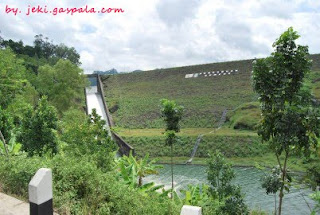
Wadaslintang Reservoir is a reservoir located in the subdistrict of Wadaslintang, Central Java, Indonesia. This reservoir has several important functions that sustain life in the surrounding residents.
Some of the main functions Wadaslintang Reservoir include:
- Hydroelectric Power Plant (HEPP)
- Fishery
- Tourism
- Prevent flooding
- Water reservoir
Wadaslintang Reservoir is located in the southern region bordering districts Wadaslintang District Padureso in Kebumen. Kali Gede Reservoir uses as its main water source with other woods several small tributaries that supply water to the reservoir Wadaslintang. In the process of development, Basin Wadaslintang takes a few villagers that requires its citizens to move residence.
The process of dam construction is done in the reign of President Suharto in 1992. Reservoir is famous as a favorite site for recreational fishing for sport fishing enthusiasts. Usually on weekends and holidays, many anglers both from within and outside the city who visit this reservoir.




