Showing posts with label Temples. Show all posts

Mt. Bromo, East Java, Indonesia

Mt. Bromo, East Java, Indonesia
Mount Bromo which stands tall at 2329 m is one of the most iconic mountain in Indonesia. Mount Bromo is situated inside Bromo-Tengger-Semeru National Park, beside Mount Semeru at East Java, Indonesia. It beckons majestically despite having the entire top blown off and with a crater inside that keeps spewing off white sulphurous smoke.

Mount Bromo is still one of the most active volcanoes in the world and there are areas that are blocked off from tourists due to its imminent danger. It sits inside the massive Tengger caldera (volcanic crater with diameter approximately 10km), surrounded by the Laut Pasir (sea of sand) of fine volcanic sand. This breathtaking and ethereal landscape have been swooned by many travelers alike.

Mt. Bromo, East Java, IndonesiaMt. Bromo, East Java, IndonesiaMt. Bromo, East Java, IndonesiaMt. Bromo, East Java, Indonesia

Myth has it that Mount Bromo is significant to the Tengger people who believe that the site is where their brave prince sacrificed his life for his family. To appease the Gods, the people will offer food and money by throwing it into the crater of the volcano once a year during annual Kasada (or Kasodo) festival.

To be awe in nature’s best combination of beauty and danger, an active volcano that can be so foreboding and desolate yet so beautiful. The view itself is almost out of this world and be the reason enough to go there! Hike up Mount Penanjakan in time to catch the sunrise over Mount Bromo. It takes about 1-2 hours hike to the first vantage point. Sun rises at 5.30am, therefore usually you have to plan when to start hiking depending on your fitness level.


Mt. Bromo, East Java, Indonesia
Maps and information are readily and easily available at one of the many official locations. Extra tip is that you may want to hike earlier to avoid the crowd and get a good spot as you may find a lot of people crowding the vantage point to view the sun rising over Mount Bromo. If you have the time and energy, there is another less-crowded vantage point higher up with unobstructed view of the sunrise. Find and scale the slope behind the shelter to get to the higher flat land.
Full Post

Sand Castle in Barocay, Philippines

Sand Castle in Barocay, Philippines
Sand Castle in Boracay is one of the main attractions of the island. Usually visible during early mornings and evenings, these simple attractions normally has the current date carved to it so tourists in the island would love to take pictures and remember the date they enjoyed in this beautiful island.

A Sand Castle is a three-dimensional work of art using the loose material consisting of grains of rock or coral. Sand castle makers use basic materials such as wood, slippers, pale, and cones among others to make their designs. Folks living in the island, who are asking for donations for their art, usually make the sand castle in the afternoon or at night and add some nice lighting to it.

Sand Castle in Barocay, Philippines

Sand Castle in Barocay, Philippines
The picturesque view of the sand castle, together with the warm colors of the lights makes it more appealing. Tourists who want to add their name to the design pays a small amount to the artist for the latter to carve it in the sculpture. Another option to enjoy the sand castle is to demolish it together with your friends but the artist would ask for a P100 to P200 fee for the demolition of their design.

Sand Castle in Barocay, Philippines
During early mornings, when the sun rises in the east, the Sand Castle will look great because the details are very clear. The carvings will be very visible and it is during this time of the day when tourists are still very fresh.
If you go to the island of Boracay, you will surely see one of these Sand Castles. Do not forget to take a picture

Sand Castle in Barocay, Philippines
The builders of the sandcastles in Bora must genius and very creative. The sandcastles have long been a popular landmark at the White Beach, attracting visitors who are taking a stroll alongg the beach. Visitors can't help but stop for awhile to take a souvenir shot with that landmark as backdrop. The sandcastles make for a spectacular background, day and night.
Full Post

Borobudur Temple, Central of Java, Indonesia

Borobudur Temple, Central of Java, Indonesia
This famous Buddhist temple, dating from the 8th and 9th centuries, is located in central Java. It was built in three tiers: a pyramidal base with five concentric square terraces, the trunk of a cone with three circular platforms and, at the top, a monumental stupa.

The walls and balustrades are decorated with fine low reliefs, covering a total surface area of 2,500 m2. Around the circular platforms are 72 openwork stupas, each containing a statue of the Buddha. Who does not know Borobudur? This Buddhist temple has 1460 relief panels and 504 Buddha effigies in its complex.

Millions of people are eager to visit this building as one of the World Wonder Heritages. It is not surprising since architecturally and functionally, as the place for Buddhists to say their prayer, Borobudur is attractive.
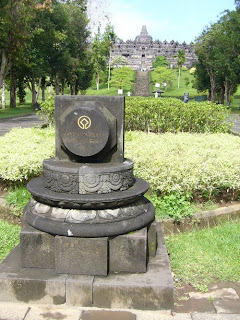
Borobudur Temple, Central of Java, IndonesiaBorobudur was built by King Samaratungga, one of the kings of Old Mataram Kingdom, the descendant of Sailendra dynasty. Based on Kayumwungan inscription, an Indonesian named Hudaya Kandahjaya revealed that Borobudur was a place for praying that was completed to be built on 26 May 824, almost one hundred years from the time the construction was begun. The name of Borobudur, as some people say, means a mountain having terraces (budhara), while other says that Borobudur means monastery on the high place.

Borobudur is constructed as a ten-terraces building. The height before being renovated was 42 meters and 34.5 meters after the renovation because the lowest level was used as supporting base. The first six terraces are in square form, two upper terraces are in circular form, and on top of them is the terrace where Buddha statue is located facing westward. Each terrace symbolizes the stage of human life. In line with of Buddha Mahayana, anyone who intends to reach the level of Buddha's must go through each of those life stages.

The base of Borobudur, called Kamadhatu, symbolizes human being that are still bound by lust. The upper four stories are called Rupadhatu symbolizing human beings that have set themselves free from lust but are still bound to appearance and shape. On this terrace, Buddha effigies are placed in open space; while the other upper three terraces where Buddha effigies are confined in domes with wholes are called Arupadhatu, symbolizing human beings that have been free from lust, appearance and shape. The top part that is called Arupa symbolizes nirvana, where Buddha is residing.

Each terrace has beautiful relief panels showing how skillful the sculptors were. In order to understand the sequence of the stories on the relief panels, you have to walk clockwise from the entrance of the temple. The relief panels tell the legendary story of Ramayana. Besides, there are relief panels describing the condition of the society by that time; for example, relief of farmers' activity reflecting the advance of agriculture system and relief of sailing boat representing the advance of navigation in Bergotta (Semarang).
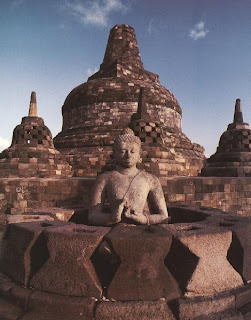
Borobudur Temple, Central of Java, IndonesiaAll relief panels in Borobudur temple reflect Buddha's teachings. For the reason, this temple functions as educating medium for those who want to learn Buddhism. Atisha, a Buddhist from India in the tenth century once visited this temple that was built 3 centuries before Angkor Wat in Cambodia and 4 centuries before the Grand Cathedrals in Europe.

Thanks to visiting Borobudur and having supply of Buddha teaching script from Serlingpa (King of Sriwijaya), Atisha was able to improve Buddha's teachings after his return to India and he built a religion institution, Vikramasila Buddhism. Later he became the leader of Vikramasila monastery and taught Tibetans of practicing Dharma. Six scripts from Serlingpa were then summarized as the core of the teaching called "The Lamp for the Path to Enlightenment" or well known as Bodhipathapradipa.

A question about Borobudur that is still unanswered by far is how the condition around the temple was at the beginning of its foundation and why at the time of it's finding the temple was buried. Some hypotheses claim that Borobudur in its initial foundation was surrounded by swamps and it was buried because of Merapi explosion. It was based on Kalkutta inscription with the writing 'Amawa' that means sea of milk. The Sanskrit word was used to describe the occurrence of disaster. The sea of milk was then translated into Merapi lava. Some others say that Borobudur was buried by cold lava of Merapi Mountain.

With the existing greatness and mystery, it makes sense if many people put Borobudur in their agenda as a place worth visiting in their lives. Besides enjoying the temple, you may take a walk around the surrounding villages such as Karanganyar and Wanurejo. You can also get to the top of Kendil stone where you can enjoy Borobudur and the surrounding scenery. Please visit Borobudur temple right away...

Source : Unesco.org - Yogyes.com
Full Post

Indonesia : Borobudur Temple

borobudur temple, indonesiaComing to the ancient temple complex of Borobudur, in the central Javanese plains 40km from Yogyakarta, Java’s second city, is like going back in time. Within half an hour of leaving Yogya’s bustling traffic, rural life opened up around us, showing little sign of change since the days of the Sailendra kings.

When we first glimpsed the full scale of the site we couldn’t believe our eyes. The colossal building evokes a feeling of timeless harmony: the site is imposing, breathtaking, beautiful and mysterious.

borobudur temple
The best time to visit the temple is in the early morning, as there’s a vibrant local morning market near the complex which is a good photo op and has some nice local handicrafts, plus the open walkways of the temple offer little relief from the sun, and the light is best at this time for photography, a favourite pastime of mine.

borobudur temple, java
One thing you should be wary of is the hawkers at the entrance – try to ignore them if possible, as even starting a conversation is license for them to follow you around all day! Try not to let them disturb your thoughts, as it’s best to enter the temple complex with a clear mind, as there’s loads to see and think about.

It was easy to imagine what it must have been like at its height, with thousands of devotees tracing their hands over the same volcanic stone we touched ourselves, straining to understand the complex philosophy encoded into the walls, just as we did.
Full Post